
By Uswa Sports · 15 November 2026
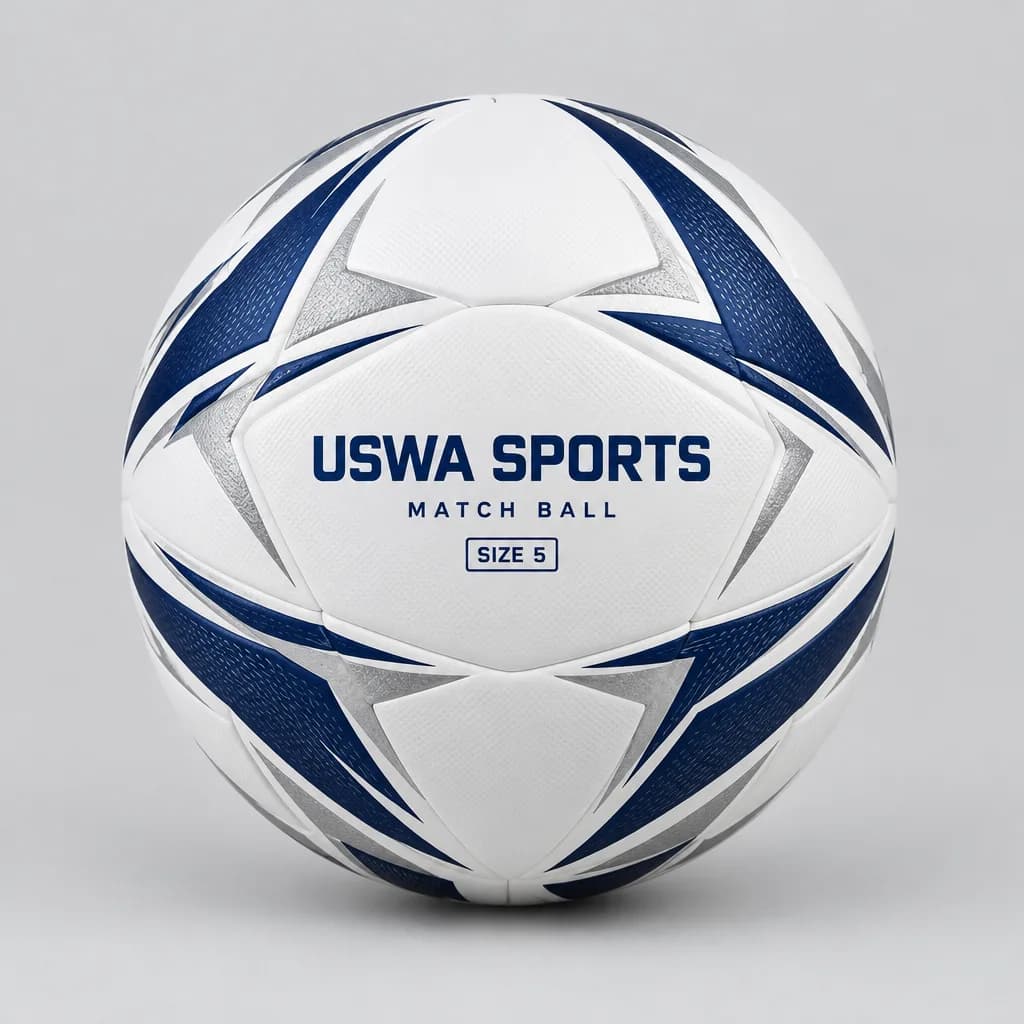
There is no single best soccer ball. The best ball for a professional match on wet grass is the wrong ball for a school playground, and a premium match ball wears out quickly if used for daily training on artificial turf. Understanding what goes into a ball helps you choose the right one, whether you are buying one ball or a thousand.
1. Construction: how the panels are joined
| Construction | How it is made | Best for |
|---|---|---|
| Thermo-bonded | Panels heat-fused, no stitching | Matches, wet weather, premium retail |
| Hand-stitched | Panels stitched by hand with waxed thread | Club training, durable all-round use |
| Machine-stitched | Panels stitched by machine | Schools, recreation, promotions, value |
Thermo-bonded balls absorb very little water and keep a consistent shape and flight. Hand-stitched balls, a speciality of Sialkot in Pakistan, are soft to the touch and very durable. Machine-stitched balls are the most economical.
2. Cover material
- PU (polyurethane): soft feel and good touch, used on most match and quality training balls.
- TPU: tougher than PU with good touch, a popular middle ground for training balls.
- PVC: very durable and inexpensive, but harder and less responsive. Best for recreational play and hard surfaces.
3. Bladder
The bladder holds the air. Butyl bladders keep their pressure for weeks and are the standard for most balls. Latex bladders feel softer and more responsive but lose air faster, so they need regular topping up. For training balls that sit in a bag between sessions, butyl is almost always the better choice.
4. Size and weight
Using the right size matters more than any other feature for young players. See our full soccer ball size guide for the chart by age, or browse size 3 and size 4 soccer balls for kids and youth players.
5. Surface
| Surface | What to choose |
|---|---|
| Natural grass | Any construction. Thermo-bonded PU for matches |
| Artificial turf | Thick PU or TPU cover, reinforced stitching |
| Hard courts and concrete | PVC or rubber, or a futsal ball indoors |
| Indoor futsal | Size 4 low-bounce futsal ball |
| Beach and sand | Soft, lightweight beach soccer ball |
Match ball vs training ball
Match balls prioritise accuracy, touch and consistency, and are used for a limited number of games. Training balls prioritise durability and air retention because they are used every day on every surface. Most clubs keep a small set of match balls and a larger stock of training balls.
A buying checklist for clubs and retailers
- Decide the use: match, training, recreation or promotion.
- Choose sizes for each age group you supply.
- Pick a construction and cover that suit the surface and budget.
- Ask for weight, circumference and rebound specifications.
- Request a physical sample and test it before ordering in bulk.
- Confirm inspection for weight, roundness and air retention before shipping.