
By Uswa Sports · 15 November 2026
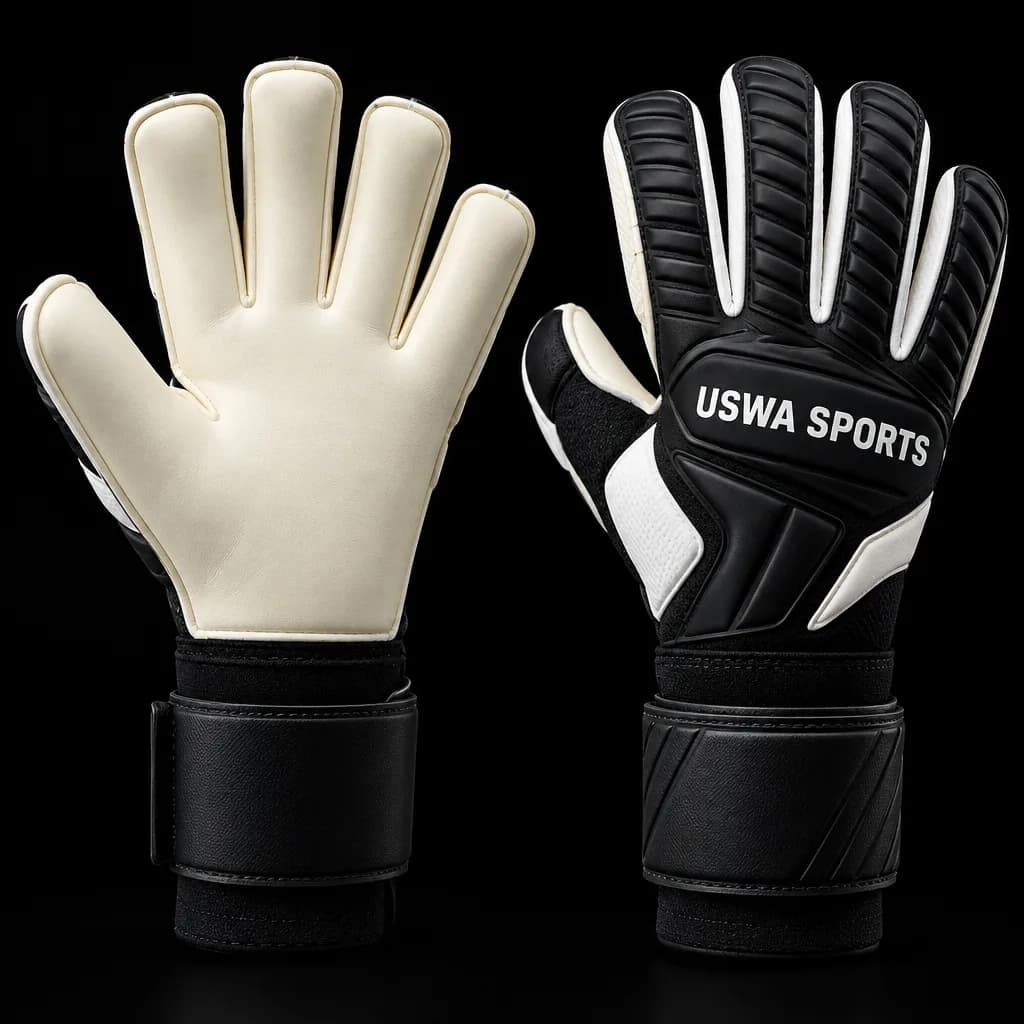
Goalkeeper gloves are the most important piece of kit a keeper owns, and the choice can be confusing: dozens of cuts, latex grades and closure systems, at prices from budget to professional. This guide explains what actually makes a difference, whether you are buying one pair or sourcing gloves for a club or a brand.
1. Choose a cut
The cut describes how the palm and fingers are stitched together. It changes how close the glove fits and how much latex touches the ball.
| Cut | How it feels | Best for |
|---|---|---|
| Negative cut | Tight, close fit with seams inside | Keepers who want maximum feel and control |
| Roll finger | Latex wraps around the fingers for a larger contact area | Catching, wet weather, all-round use |
| Flat palm | Traditional, roomy fit with seams outside | Beginners, young keepers, cold weather |
| Hybrid | Mixes two cuts, such as roll fingers with a negative palm | Keepers who want grip and a snug fit |
2. Understand the latex
Latex is the foam on the palm that grips the ball. Softer, stickier latex grips better but wears out faster, while harder latex lasts longer but feels less tacky. Thickness matters too: 3 to 4 mm is standard, and some match gloves use 4 mm or more for cushioning.
- Match-grade (German or contact latex): the best grip on grass, but it wears quickly on artificial turf.
- Training-grade latex: tougher and longer lasting, with good grip for daily sessions.
- Hard-ground latex: built for artificial turf, sand-based pitches and indoor courts.
- Wet-weather latex: designed to grip when damp, often used with a little water on the palm.
3. Decide on finger protection
Finger protection, or "finger saves", uses removable or fixed spines that stop fingers bending backwards. They are a good idea for young keepers and anyone recovering from a finger injury. Many experienced keepers prefer gloves without them for a more natural feel, so it is a personal choice.
4. Get the size right
Measure around the widest part of the palm (excluding the thumb), or from the tip of the middle finger to the bottom of the palm. A goalkeeper glove should leave around 0.5 to 1 cm of space at the fingertips so the latex is not stretched. Sizes vary between brands, so treat this chart as a starting point.
| Glove size | Typical age | Hand length (middle finger to wrist) |
|---|---|---|
| 4 | 6 to 8 | 13 to 14 cm |
| 5 | 8 to 10 | 14 to 15 cm |
| 6 | 10 to 12 | 15 to 16 cm |
| 7 | 12 to 14 | 16 to 17 cm |
| 8 | Adult small | 17 to 18 cm |
| 9 | Adult medium | 18 to 19 cm |
| 10 | Adult large | 19 to 20 cm |
| 11 | Adult extra large | 20 cm and over |
5. Check the wrist closure
Closures range from a wide hook-and-loop strap that wraps the wrist, to strapless gloves with an elasticated cuff. Strapped gloves give more wrist support and are easier to put on. Strapless designs feel lighter and fit closer, but need an accurate size.
6. Make your gloves last longer
- Use a separate pair for training and keep the best pair for matches.
- Dampen the latex slightly before use, as most latex grips better when a little wet.
- Rinse in lukewarm water after every use and gently squeeze out dirt. Never use a washing machine.
- Dry naturally away from radiators and direct sun, which harden the latex.
- Store gloves palm to palm in a glove bag, never folded or rolled with the latex touching the back.
Buying goalkeeper gloves for a club, academy or brand
Clubs and academies often order a training pair and a match pair for every keeper in club colours. Brands launching a goalkeeping range choose cuts and latex grades for each price point and add their own logo, strap design and packaging. Sialkot in Pakistan is one of the main centres for goalkeeper glove production, which is why many glove brands source there. Matching kit is easy to add: see custom soccer uniforms and custom soccer balls.